Retargeting Campaign Strategies for Toronto E-commerce Businesses
Maximizing Business Visibility with Effective Retargeting Strategies
Retargeting campaign strategies for Toronto e-commerce businesses play a crucial role in driving sales by reconnecting with visitors who have interacted with products but have not yet converted. Given that cart abandonment rates can exceed 70%, a carefully crafted retargeting approach enables businesses to reclaim potential customers left behind by initial acquisition efforts. Key to success is aligning messaging, timing, tracking, and offers with the visitor’s behaviour for maximum impact.
For Toronto-based companies listed in business directories or operating locally, delivering a clear and trusted retargeting message is essential. Retailers can address concerns such as shipping timelines, currency, return policies, and product availability, helping to convert hesitant shoppers who may be comparing options or timing their purchase decisions. For a deeper dive into retargeting strategies tailored to Toronto e-commerce, see the original article on Zigma’s resources.
Integrating retargeting efforts into a broader customer acquisition and conversion system—often initiated with Google Ads Management—ensures that follow-up campaigns reflect the user’s site interaction and increase the likelihood of completing a purchase.
How Retargeting Enhances Business Directory Listings and Customer Connections
For businesses leveraging online directories to attract local customers, retargeting extends the reach of digital marketing by reconnecting with individuals who have engaged with your listings or website. Utilizing data from website tags, product catalogs, and customer information, retargeting campaigns deliver personalized ads that follow shoppers after leaving your site—whether through social platforms like Meta or Google Display Network.
The distinction between prospecting and retargeting lies in intent: while business directories help capture initial interest and generate leads, retargeting addresses people who have already shown clear signals—a vital step in converting interest into sales. For example, potential buyers who checked product details should receive specific, product-focused messages, while those near checkout may require support around shipping or returns.
Robust tracking across actions like product views, cart additions, and purchases forms the backbone of meaningful retargeting. Coupling this with expert Website Design & Development and optimization enables businesses listed in directories and on their own websites to funnel visitors toward conversion-ready pages efficiently.
Leveraging Localized Retargeting to Stand Out in Toronto’s Competitive Market
Businesses featured in Toronto-focused online directories face competition not only from Canadian peers but also from American and international sellers. In this landscape, localized retargeting messages that emphasize relevant details—prices in CAD, GTA delivery estimates, local pickup options, straightforward return policies, and inclusion of duties—can foster trust and improve conversion rates.
Incorporating local user-generated content (UGC) into retargeting campaigns enhances credibility by showcasing real customers in familiar Toronto environments, such as downtown condos or waterfront areas. This contextual storytelling resonates with customers far better than generic imagery, especially for apparel, home goods, and lifestyle products.
Ensuring Promises Align with Operational Capacity
Claims such as “Fast GTA delivery” must be supported by reliable logistics to avoid disappointing customers. Splitting campaigns by delivery zones like downtown Toronto, North York, Scarborough, and Etobicoke allows businesses to manage expectations accurately and optimize advertising budgets effectively.
Six Strategic Retargeting Approaches Tailored for Toronto Businesses
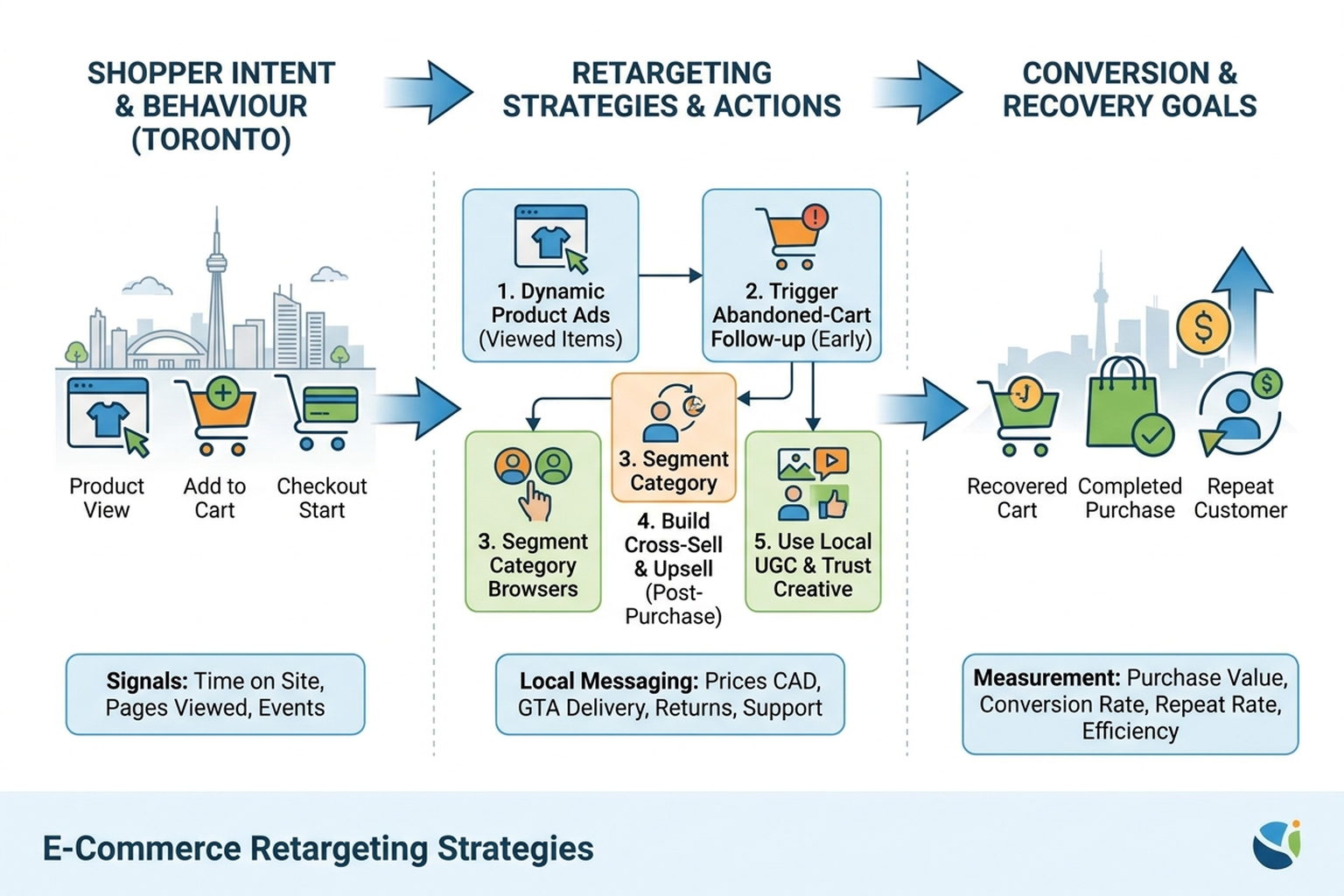
Effective retargeting campaigns prioritize audiences based on shopper intent, from those closest to purchase to broader browsers. It’s essential to apply frequency caps and exclude recent purchasers to maintain budget efficiency and a positive customer experience.
1. Employ Dynamic Product Ads for Item-Specific Retargeting
Dynamic product ads pull real-time product information—names, images, prices, and availability—directly from your catalogue, allowing you to show visitors exactly the items they explored or left behind in their carts.
Target audience: Segment users into product viewers, cart abandoners, and checkout abandoners.
Localization tip: Highlight Canadian-specific offers such as “Prices in CAD” or “Free GTA shipping” only when accurate.
Example: If a shopper viewed winter boots, immediate ads showing sizes and delivery details for those boots outperform generic brand promotions.
2. Initiate Abandoned Cart Follow-Ups Without Delay
Capturing customers early—right after adding an item to a cart—helps engage hesitant shoppers before they lose interest or explore competitors. Sending an email within 30-60 minutes while the item is fresh in their mind encourages recovery.
Messaging: Provide reassurance by addressing shipping, returns, and an easy path back to checkout.
Exclusions: Suppress follow-ups for completed purchases or items out of stock.
Example: A skincare brand can reinforce product benefits and Canadian shipping policies in a gentle reminder instead of leading with discounts.
3. Differentiate Browsers by Category from Product-Specific Visitors
Shopper intent varies: someone browsing a category has less buying urgency than a visitor viewing a specific product. Tailoring ads accordingly increases relevance.
Audience segmentation: Use engagement metrics to separate casual browsers from serious buyers.
Budgeting advice: Prioritize spend on high-intent audiences like cart abandoners over broad category visitors.
Example: A home décor business might show general lighting collections to category browsers, but targeted ads for a pendant light to visitors who repeatedly viewed that item.
4. Expand Post-Purchase Opportunities through Cross-Sell and Upsell Retargeting
Retargeting continues beyond initial conversion by promoting complementary or upgraded products after purchase and product usage.
Cross-sell: Suggest related items that complete a customer’s purchase, for example, gloves and scarves after a winter coat.
Upsell: Offer premium accessories or bundles only when beneficial to the customer.
Example: Electronics stores can showcase device accessories or extended warranties to existing customers.
5. Use Local UGC and Trust-Building Content
Customer photos, reviews, and videos set in recognizable Toronto locations reinforce authenticity and help hesitant buyers.
Testing: Evaluate how UGC performs against traditional product images with the same audience and offer.
Compliance: Always secure permissions before featuring customer content in paid campaigns.
Example: A local apparel brand might share a customer video detailing winter jacket performance during a cold Toronto commute.
6. Apply Frequency Caps, Exclusions, and Performance Tracking
Overexposure leads to fatigue and wasted ad spend. Managing frequency, rotating creatives, and excluding purchasers or customers with open support tickets maintains engagement and protects your brand.
Measurement: Track conversions, average order value, repeat purchases, and cost per recovered order to optimize campaigns.
Testing methodology: Alter only one aspect at a time—creative, timing, audience window—to assess true impact.
Example: A business may find that a seven-day audience window for cart abandoners is more cost-effective than 30 days.
Selecting a Digital Marketing Partner for Business Directory Success
When choosing an agency for retargeting and paid media, ensure they provide transparency around data sources, audience segments, and campaign validation. Beautiful ads cannot make up for inaccurate tracking, poor product feeds, or confusing website experiences.
Toronto businesses listed in directories should inquire if an agency can synchronize campaigns with site speed, product catalogs, email flows, analytics, and landing page optimization. A credible digital marketing agency Toronto understands acquisition costs in the context of repeat business, profitability, and customer lifetime value.
- Own your tracking: Agencies should grant access to ad accounts, analytics, and tag managers so you maintain control.
- Audience clarity: Demand detailed explanations of how visitor, cart, checkout, purchaser, and customer segments are defined.
- Comprehensive reporting: Seek insights connecting spend to orders and revenue, not just impressions.
- Technical expertise: The partner must address broken events, feed errors, slow pages, and checkout bottlenecks.
Zigma Internet Marketing offers comprehensive digital marketing services integrating paid media, analytics, technical SEO, and conversion optimization tailored for the Toronto market.
Impact Factors Influencing ROI in Directory-Driven Digital Campaigns
The success of retargeting extends beyond ad costs to factors like product-market fit, inventory readiness, website speed, content quality, and checkout ease. Even the most relevant ad cannot convert visitors on a confusing or slow website.
Businesses advertising via local directories should segment prospecting and retargeting campaigns when measuring performance, understanding that conversions may be influenced by multiple digital touchpoints, including email campaigns and organic search.
- Feed accuracy: Ensure product information is current and matches the ads.
- Conversion rate optimization: Fast pages, transparent shipping info, and simple checkout enhance returning visitor success.
- Privacy compliance: Implement consent-aware tracking aligned with Toronto and Canadian regulations.
- Creative targeting: Customize messages according to user intent for better engagement.
Aligning SEO and PPC with Business Directory Marketing
SEO and paid retargeting complement each other within the customer journey. While SEO attracts shoppers researching products via unpaid search results and builds long-term category authority, PPC retargeting re-engages warm visitors who already interacted with your business online.
For Toronto businesses listed in local directories, combining a strong seo company Toronto with proficient Google Ads management Toronto results in expanded visibility and more qualified leads. Expert seo services Toronto also improve site technical health and content relevance, enhancing shopper confidence.
- SEO for lasting organic demand: Focus on categories, guides, comparisons, and site performance to attract early-stage buyers.
- PPC for precise reach: Target high-intent customers and warm audiences with controlled budgets.
- Retargeting for completing sales: Convert engaged visitors who need an additional nudge or reassurance.
How Toronto Businesses Can Thrive Through Online Directories and Retargeting
Competing with large marketplaces and international sellers requires Toronto businesses to provide crystal-clear product information, dependable fulfillment, and trusted customer support. Local SEO efforts tied to business directory listings bolster visibility for geographically relevant searches.
Optimizing your Google Business Profile and local directory listings ensures accurate hours, contact details, and positive reviews, which help drive store visits and e-commerce traffic.
- Build customer trust upfront: Ensure product pages answer FAQs about size, compatibility, shipping, warranties, and returns.
- Enhance first impressions: Prioritize mobile usability, inventory filters, fast loading, and seamless checkouts with professional website design Toronto.
- Leverage content marketing: Use blogs and guides to educate customers and highlight local use cases.
- Connect marketing spend to results: Partner with a lead generation agency Toronto that measures revenue impact beyond simple lead volume.
Common Retargeting Pitfalls That Hurt Conversion Rates
Overly broad targeting wastes budget by showing ads to people with low intent or those who already purchased. Likewise, relying solely on platform attribution data without supplemental analytics overlooks the full customer journey, risking misinformed budget shifts.
Effective retargeting is precise.
Product viewers need focused product reminders.
Cart abandoners require reassurance about checkout, shipping, and returns.
Past customers appreciate relevant post-purchase offers rather than repeated acquisition ads.
Finding a Reliable Retargeting Partner in Toronto’s Business Ecosystem
A qualified ppc agency Toronto will audit your tracking setup before increasing ad spend, verify product feed health, and segment audiences based on meaningful customer actions. Effective partnerships include landing-page and checkout reviews since converting paid traffic depends on a strong on-site experience.
Zigma Internet Marketing, located in Markham and serving Toronto and the GTA, blends paid ads, feed management, Google Analytics 4 expertise, technical SEO, and conversion optimization. As a Google Partner, Zigma provides transparent KPI reporting aligned with your business outcomes.
When exploring online marketing Toronto options or selecting a marketing agency GTA, expect initial conversations to focus on your product mix, customer journey, and operational realities—not generic marketing promises.
Elevate Your Local Retargeting Strategy Today
Explore audience segmentation, product-feed quality, conversion tracking, and landing page optimization with Zigma Internet Marketing.
FAQs About Retargeting Strategies for Toronto Businesses in Directories
Sending the first reminder within 30 to 60 minutes of cart abandonment is effective while the product interest remains fresh. Paid retargeting can start soon after the cart event but must control frequency to avoid ad fatigue.
No. Product viewers may require educational content such as sizing or reviews, whereas cart abandoners typically respond better to reminders addressing delivery, returns, and checkout support.
Accurate operational facts like prices in CAD, GTA delivery timelines, local pickup options, Toronto-based customer service, and return handling improve ad relevance. Avoid unsubstantiated local claims that don’t influence purchasing decisions.
Yes. Post-purchase retargeting drives replenishment, accessories, upgrades, and referrals. However, campaigns must exclude buyers from ads promoting products they already own unless repeat orders are viable.
Look at conversion rates, average order value, repeat purchase frequency, cost per recovered order, product availability, and margin contribution. Cross-check platform conversions with site analytics and store data for a balanced view.
Essential Retargeting Checklist for Toronto Business Directory Listings
Successful retargeting depends on solid data tracking and a user experience that eases purchase decisions. Focus on cart and checkout audiences, leverage dynamic product ads where feasible, localize claims to match Canadian operations, and exclude purchasers from acquisition-style campaigns.
Analyze performance by audience segment to identify if challenges lie in creative messaging, product page clarity, shipping communication, checkout efficiency, or campaign measurement.
Related Topics:

Recent Posts

Laser Hair Removal for Dark Skin With Safe Treatment Guidance
Best Meta ads connector – Manus.im vs Claude